
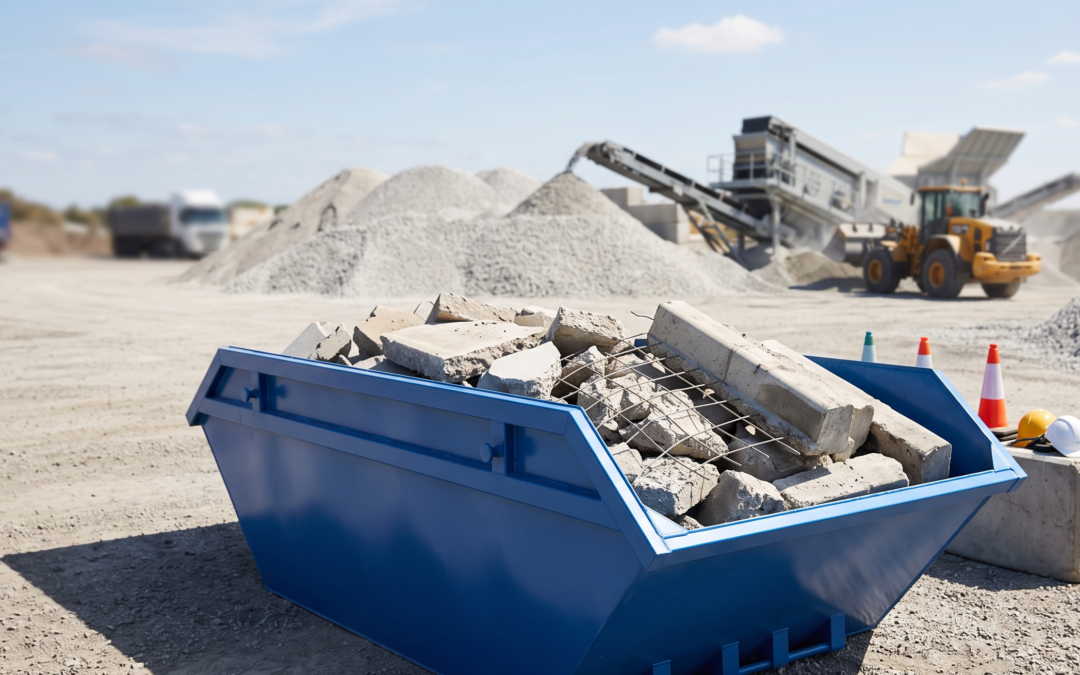
Most people assume that heavy waste costs more to dispose of. It makes intuitive sense: concrete weighs a lot, it is hard to move, and it fills bins fast. So hiring a skip bin for concrete must be expensive, right?
Not necessarily. In many cases, a bin loaded with clean concrete is actually cheaper than a bin loaded with mixed general waste. And the reason comes down to what happens to the concrete after it leaves your site.
Concrete Is One of the Most Recyclable Materials in Australia
Unlike mixed household waste or contaminated renovation rubble, concrete has a clear and profitable second life. When clean concrete arrives at a recycling facility, it gets crushed into aggregate. That aggregate is then sold and reused as road base, sub-base for driveways and car parks, drainage material, fill for construction sites, and base course for new concrete pours.
This recycled aggregate is in constant demand across the construction industry in Sydney. Every new housing estate, road project, and commercial development in Western Sydney and the Macarthur corridor uses aggregate. Recycled concrete aggregate is cheaper than quarried virgin material, performs to the same engineering standards for many applications, and reduces the need for new quarry extraction.
Because the recycled product has commercial value, the processing facility makes money from it. That changes the economics of the entire disposal chain. The tip fee for clean concrete at a recycling facility is significantly lower than the tip fee for mixed waste at a landfill. And those savings get passed through to the skip bin operator and, ultimately, to you.
What “Clean Concrete” Actually Means
The cost advantage only applies to clean concrete. In the waste industry, “clean” means the concrete is free of contaminants and other waste types.
Clean concrete includes: plain concrete slabs, concrete footings, concrete blocks, concrete pipes, kerbing, and concrete with reinforcing mesh (reo) embedded in it. Reo mesh is expected in most structural concrete and does not disqualify the load. The recycling facility separates the steel from the crushed concrete using magnets, and the steel gets recycled separately.
Clean concrete does not include: concrete mixed with timber, plastic, insulation, plasterboard, soil, general rubbish, or other non-concrete materials. If these items are mixed in, the load is reclassified as mixed heavy waste or construction waste, and the processing cost goes up.
The distinction matters because it directly affects your price. A concrete skip bin loaded with only concrete (and some reo) qualifies for the lower disposal rate. The same bin with a few pieces of timber and a bag of household rubbish thrown in may not.
How Concrete Disposal Pricing Works
Skip bin pricing for concrete is driven by weight, not just volume. Concrete is heavy: a single cubic metre weighs roughly 2.2 to 2.4 tonnes. That means a 4m skip bin filled to the brim with concrete would weigh close to 9 or 10 tonnes, which far exceeds the safe transport weight for that bin size.
Because of this, concrete bins come with strict weight limits. The bin size sets the volume, but the weight limit sets how full you can realistically load it. A 4m concrete bin might have a weight limit of 4 to 6 tonnes, which means you can only fill it roughly halfway before hitting the allowance.
This is not a trick to charge you more. It is a physics and road safety constraint. An overloaded truck is dangerous and illegal to operate on public roads.
The key to getting the best price on concrete disposal is understanding this relationship between bin size and weight limit. In practice, it often makes more sense to order a larger bin and load it to the weight limit rather than ordering a smaller bin and risking an overweight surcharge.
Concrete vs Mixed Heavy Waste: The Price Difference
Here is where the savings become clear. When you keep concrete separate from other materials, the disposal facility processes it through the crushing and screening line. The output is a saleable product. The tip fee reflects this.
When concrete is mixed with other heavy materials like masonry (bricks, tiles, pavers), the load can still go through a similar crushing process, but sorting out the non-concrete items adds labour and time. The tip fee is usually a step higher than pure concrete, but still well below mixed general waste rates.
When concrete is mixed with general rubbish, timber, plastics, and other construction debris, the entire load gets treated as mixed construction waste. It goes through a more complex (and more expensive) sorting process, with a much lower recycling rate. The tip fee is significantly higher, and that higher cost flows through to your skip bin price.
The practical lesson: if you are doing a job that produces both concrete and general waste, order two bins. One for concrete and one for everything else. The combined cost of two properly categorised bins is often less than a single mixed waste bin, because the concrete bin attracts the lower disposal rate.
Common Jobs That Produce Concrete Waste
Driveway removal. Ripping out an old concrete driveway produces a large volume of clean concrete, often with reo mesh. A standard two-car driveway can generate 4 to 8 cubic metres of concrete depending on thickness.
Slab demolition. Removing a concrete slab (house slab, garage slab, shed slab) produces heavy, clean concrete waste. Slab thickness varies, but even a 100mm slab across a modest footprint generates several tonnes.
Footings and stumps. Excavating old concrete footings during a restump or foundation repair produces heavy waste in smaller volumes. A dedicated concrete bin makes sense here because the weight adds up fast even when the volume looks manageable.
Path and patio removal. Concrete paths, pavers on concrete beds, and outdoor entertaining areas all produce clean concrete waste when demolished.
Retaining wall demolition. Concrete block retaining walls generate a combination of concrete blocks and any backfill material behind the wall. If the backfill is clean soil, it may need a separate bin.
Pool demolition. In-ground concrete pools produce a significant volume of reinforced concrete. Pool demolitions usually require a large bin (10m or 12m) and multiple loads depending on the pool size.
Tips for Getting the Best Price on Concrete Disposal
Keep it clean. The most effective way to reduce your concrete disposal cost is to keep the concrete separate from everything else. Do not throw timber offcuts, packaging, or general rubbish into the concrete bin. Even a small amount of contamination can reclassify the load.
Know the weight limit. Ask the operator what the weight allowance is for the bin size you are ordering. Load to the weight limit, not the volume limit. A half-full bin that is at its weight capacity is a correctly loaded concrete bin.
Break up large pieces. Massive slabs and footings are harder for the recycler to process. If you can break concrete into manageable pieces (roughly the size of a basketball or smaller) before loading, it makes the crushing process more efficient. Some operators prefer this; others handle it at the facility. Ask when you book.
Mention reo mesh upfront. Reinforced concrete with steel mesh is accepted, but it helps the operator if they know in advance. Protruding reo mesh can be a safety hazard during transport, so cut or bend exposed mesh so it sits within the bin walls.
Ask about masonry pricing. If your load includes a mix of concrete, bricks, tiles, and pavers but no other waste types, it may qualify as a masonry load rather than general construction waste. Masonry rates are typically lower than mixed rates because all of these materials are recyclable.
The Bottom Line
Concrete disposal is not the budget blowout most people expect. Because concrete is highly recyclable and has commercial value as crushed aggregate, the disposal cost is often lower than mixed general waste.
The key is keeping the concrete clean and separate. A dedicated concrete bin, loaded within its weight limit, gets you the best price and the best environmental outcome. Mixing concrete with general rubbish costs you more and reduces the chance of the material being recycled.
If you have a job producing concrete waste in South-West Sydney, call us and we will give you a quote based on the actual volume and weight. No guessing, no surprises.